How to Take Better Islamic Study Notes: A Practical Guide
Try Maktabook
Writing down everything a teacher says is not note-taking, and notes you never revisit lose much of their value. A good Islamic study note helps you understand, remember and act on what you learned. Here is how to take notes that do that.
What makes a good Islamic study note?
- Selective. It records the key ideas, not the whole lecture.
- Accurate. It names the verse, or the hadith’s collection and number, so you can check it later.
- Clear about whose words are whose. Your teacher’s explanation and your own thoughts are marked separately.
- Easy to find again. It sits in a place you will look when you revise.
- Ends in action. It says what you will do with what you learned.
How should you take notes during an Islamic lecture?
Don’t write everything the teacher says
You can’t write as fast as someone speaks, and trying to means you stop following the explanation. Listen first, then write the main point of each section and anything the teacher stresses.
Capture the concept, the explanation and the evidence
For each topic, write three things: the concept (what is being taught, such as a ruling or a belief), the explanation (why or how, in the teacher’s words), and the evidence (the verse or hadith it rests on).
Keep the teacher’s explanation separate from your own thoughts
Label your own reflections, for example with “My reflection:”. Months later, you need to know what was taught and what was only your guess.
Record references accurately
For a verse, write the surah name and the verse number. For a hadith, write the collection and number, and the narrator if the teacher gives it. If the teacher doesn’t give the reference in class, write “ref?” and look it up afterwards on a reliable site such as Quran.com or Sunnah.com.
Write down your questions
When something is unclear, write the question down with a “Q:” and keep listening. Ask your teacher at the end of the lesson or afterwards.
Example: notes from a lesson
Here is what a student might write after a lesson on a hadith about loving for others what you love for yourself:
- Topic: Loving for your brother what you love for yourself
- Concept: Faith is not complete until you wish for others what you wish for yourself
- Teacher’s explanation: Applies to religious and worldly good, not only gifts
- Evidence: Sahih al-Bukhari 13, Sahih Muslim 45a; related verse, Quran 49:10
- My reflection: I need to check how I react when someone else succeeds
- Q: Does it also mean disliking for others what I dislike for myself?
- Action: This week, make dua for a classmate by name
What’s the best way to take notes on a Quran verse or a Hadith?
For a verse, record:
- The surah and verse number
- The Arabic text, or at least the key words
- The translation you are using
- The tafsir point, and which tafsir or teacher it came from
- Your reflection
For a Hadith, record:
- The collection and number
- The narrator, meaning the Companion who reported it
- The wording, or a short summary
- The teacher’s explanation
- Your own understanding, labeled as yours
- The grading, if your teacher mentions it
Should you take handwritten or digital notes?
Both work. Handwriting is slower, which can push you to be selective, and it suits writing on class handouts. Typing is faster, and it lets you search, reorganize and look up references. What matters more than the medium is what you do with the notes afterwards: how you process them, review them and test yourself. Choose the one you will keep up.
How should you organize your Islamic notes?
Group notes by subject first, then by lesson. A common split:
- Quran and tafsir
- Aqidah (creed)
- Fiqh (jurisprudence)
- Hadith
- Seerah (the biography of the Prophet ﷺ)
- Arabic and Islamic terminology
- Personal reflections
Date every lesson, and add a line linking related topics, such as a fiqh ruling to the verse or hadith it comes from. This makes revision easier: before an exam, you open one subject and find everything on it, with the evidence next to the ruling.
Why should you review your notes?
Collecting information is not the same as learning it. Review soon after the lesson, while your shorthand still makes sense: fill in missing references and answer the questions you wrote down.
Then use active recall. Close your notes and explain the lesson from memory, out loud or on paper. Open the notes and check what you missed. In a study by Roediger and Karpicke, students who tried to recall a text remembered more a week later than students who restudied it. Do this once a week for each subject, and take whatever you couldn’t explain to your teacher.
How do you turn Islamic knowledge into action?
Seeking knowledge is not only collecting information. The Prophet ﷺ said that actions are judged by intentions (Sahih al-Bukhari 1, Sahih Muslim 1907), so check why you are studying. He ﷺ also used to seek refuge in Allah سبحانه وتعالى from knowledge that does not benefit (Sahih Muslim 2722), and he listed knowledge that people benefit from among the deeds that continue after death (Sahih Muslim 1631).
End every lesson by answering these questions in your notes:
- What did I learn?
- What do I need to understand better?
- How can I act on it?
- Optional: is there anything worth sharing with others? Only share what I have checked with my teacher or a reliable source.
How do you choose the right tools for Islamic note-taking?
Students often switch between their notes, a Quran website, a hadith collection and a PDF, and lose their place each time. Whatever tool you use, the techniques above still apply. A tool should remove that switching.
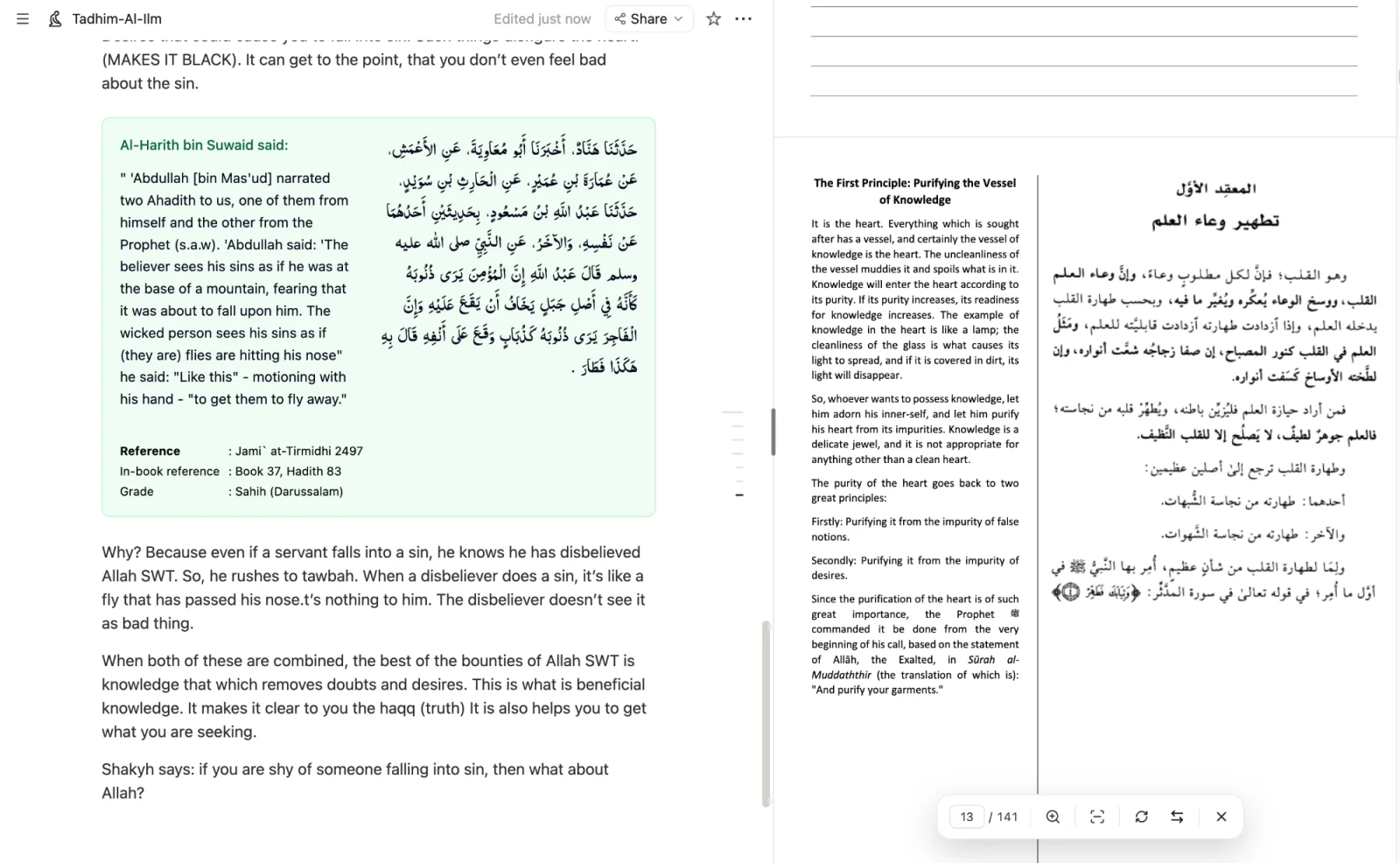
Maktabook is a free note-taking app built specifically for students of knowledge. It puts the sources inside your notes:
- Insert Quran verses directly into your notes, in your preferred translation language and Arabic text size
- Add hadith with their references
- Open a class PDF beside your notes
- Organize notes into books, one per subject
For example, to note the hadith on loving for your brother what you love for yourself (Sahih al-Bukhari 13), you insert it from the built-in hadith collection and it appears in your note with its reference. Verses go in the same way.
To compare options, see our guide to the best apps for taking notes in Islamic studies.
Start small and stay consistent
Aisha (رضي الله عنها) reported that the Prophet ﷺ said the most beloved deeds to Allah سبحانه وتعالى are the most consistent, even if small (Sahih al-Bukhari 6464, Sahih Muslim 783b). Pick one lesson this week. Write the key points instead of everything, record the references, and finish with the reflection questions.
May Allah سبحانه وتعالى grant us beneficial knowledge and the ability to act upon it. Ameen.