How to Start Seeking Islamic Knowledge: A Beginner’s Guide
Try Maktabook
There is more Islamic knowledge than anyone can finish in a lifetime, and that is why so many beginners stall before they start. Which subject first? Which teacher? Which book? You don’t need all those answers today. You need one subject, one teacher you can trust, and a lesson on your calendar this week.
This guide covers what seeking knowledge means, where to begin, how to judge a teacher, and what a first week can look like. It ends with a sample note from a first lesson.
What does it mean to seek knowledge in Islam?
Seeking knowledge is an act of worship, and the texts encourage it directly. Allah سبحانه وتعالى tells the Prophet ﷺ to say, “My Lord, increase me in knowledge” (Quran 20:114), and asks whether those who know are equal to those who do not (Quran 39:9). The Prophet ﷺ said that whoever takes a path to seek knowledge, Allah سبحانه وتعالى makes easy for him a path to Paradise (Sahih Muslim 2699). He ﷺ also said that when Allah سبحانه وتعالى wants good for someone, He gives him understanding of the religion (Sahih al-Bukhari 71, Sahih Muslim 1037b).
Scholars separate the knowledge every Muslim must have from deeper study that only some of the community need to take on. The first kind is what you need to believe correctly and to perform your obligatory acts correctly. This is the sense of the hadith in Sunan Ibn Majah 224, which says that seeking knowledge is an obligation on every Muslim. A beginner’s first job is the first kind.
Start with your intention
The Prophet ﷺ said that actions are judged by intentions (Sahih al-Bukhari 1, Sahih Muslim 1907). That covers study as much as prayer. Ask yourself why you are learning. Knowledge you act on and pass on is the kind that keeps benefiting you, and the Prophet ﷺ listed knowledge that people benefit from among the three things that continue after a person dies (Sahih Muslim 1631).
Checking your intention is something you repeat, not something you do once. It drifts as soon as you start to know more than the people around you.
Where should a beginner start?
These subjects are not a ladder. Most teachers and courses mix them, and you can study two at the same time. What matters is knowing why each one is there, so you can pick the one your life needs first.
- Aqidah (creed). This is what you believe and why. Every act of worship rests on it, so the basics, like the six pillars of iman, come early.
- Fiqh of worship. Purification, prayer, fasting and zakat where it applies. This is the knowledge you use on an ordinary day, and it decides whether your worship is done correctly.
- Seerah. The life of the Prophet ﷺ. It shows how the Quran and the rulings were lived by real people, and it makes the other subjects easier to remember.
- Quran with tafsir. The meaning of what you already recite in prayer. A common way in is the short surahs you pray with, one at a time.
- Hadith. Start with a small collection, such as the Forty Hadith of Imam al-Nawawi. Its first hadith is the one about intentions, which fits where you are right now.
If you’re unsure, begin with the subject your daily life needs most. For many beginners that’s how to pray correctly and the basics of belief. A teacher can adjust the order for you.
In the Book of Knowledge, al-Bukhari records that Ibn Abbas (radiyallahu anhuma) described the rabbaniyyin as wise and learned. The same chapter heading adds that a rabbani teaches people the smaller matters before the larger ones. Learners follow the same order. Foundations first.
How do you find a qualified teacher?
Ibn Sirin said that this knowledge is religion, so look carefully at whom you take your religion from (Sahih Muslim, Introduction). He said it about narrating hadith, and the scholars apply it to religious knowledge in general. A good teacher corrects your mistakes, tells you what to study next, and holds you to the work.
Start with your local masjid and ask who teaches there and who they studied under. Then check a few things before you commit:
- Where and under whom they studied. A real teacher can name their own teachers.
- Formal training or an ijazah. A recognised program or a chain of study shows they were taught and tested.
- Who vouches for them. Look for recommendations from scholars you already trust.
- What they teach from. Established texts with sources, not only personal opinion.
- How they handle questions. A teacher who says “I don’t know, ask this scholar” is safer than one who answers everything.
Followers and confidence are not credentials. Short clips are fine as reminders, but they rarely teach a subject in order.
What does a first week look like?
Aisha (radiyallahu anha) reported that the Prophet ﷺ said the most beloved deeds to Allah سبحانه وتعالى are the most consistent, even if small (Sahih al-Bukhari 6464, Sahih Muslim 783b). So the first week is about setting up something you can repeat, not doing a lot.
- Day 1. Pick one subject. Write one sentence on why you want to learn it.
- Day 2. Ask at your masjid or among people you trust for teachers or courses on that subject. Shortlist two.
- Day 3. Check each against the list above. Contact your first choice.
- Days 4 and 5. Book or attend your first lesson. Take notes.
- Day 6. Reread your notes and write down your questions.
- Day 7. Fix a weekly time for study, one you can keep even on a bad week.
What should you write after a lesson?
Notes turn a lesson into something you can return to. After each class, write four things: the topic, the main benefit, the Quran or hadith reference, and one action you will take. Here is what that might look like after a first lesson on the Forty Hadith:
- Topic: Hadith 1, actions are judged by intentions
- Key benefit: The same act can be worship or just habit, depending on why I do it
- References: Sahih al-Bukhari 1, Sahih Muslim 1907; related verse, Quran 98:5
- Action point: Before each study session this week, say why I’m studying
The hadith teaches that the reward for a deed depends on the intention behind it. Quran 98:5 calls us to worship Allah سبحانه وتعالى alone with sincere devotion. Before a lesson on prayer, for example, you can set the intention to learn how to pray correctly for the sake of Allah سبحانه وتعالى.
The reference line is the part most people skip, and the one you’ll want a year later. Looking up a verse or hadith usually means leaving your notes for another tab. Maktabook is an Islamic note-taking app designed for students of knowledge. Typing /quran or /hadith inside a note brings the reference in, and Tafsir and PDFs open beside it, so you stay on one page.
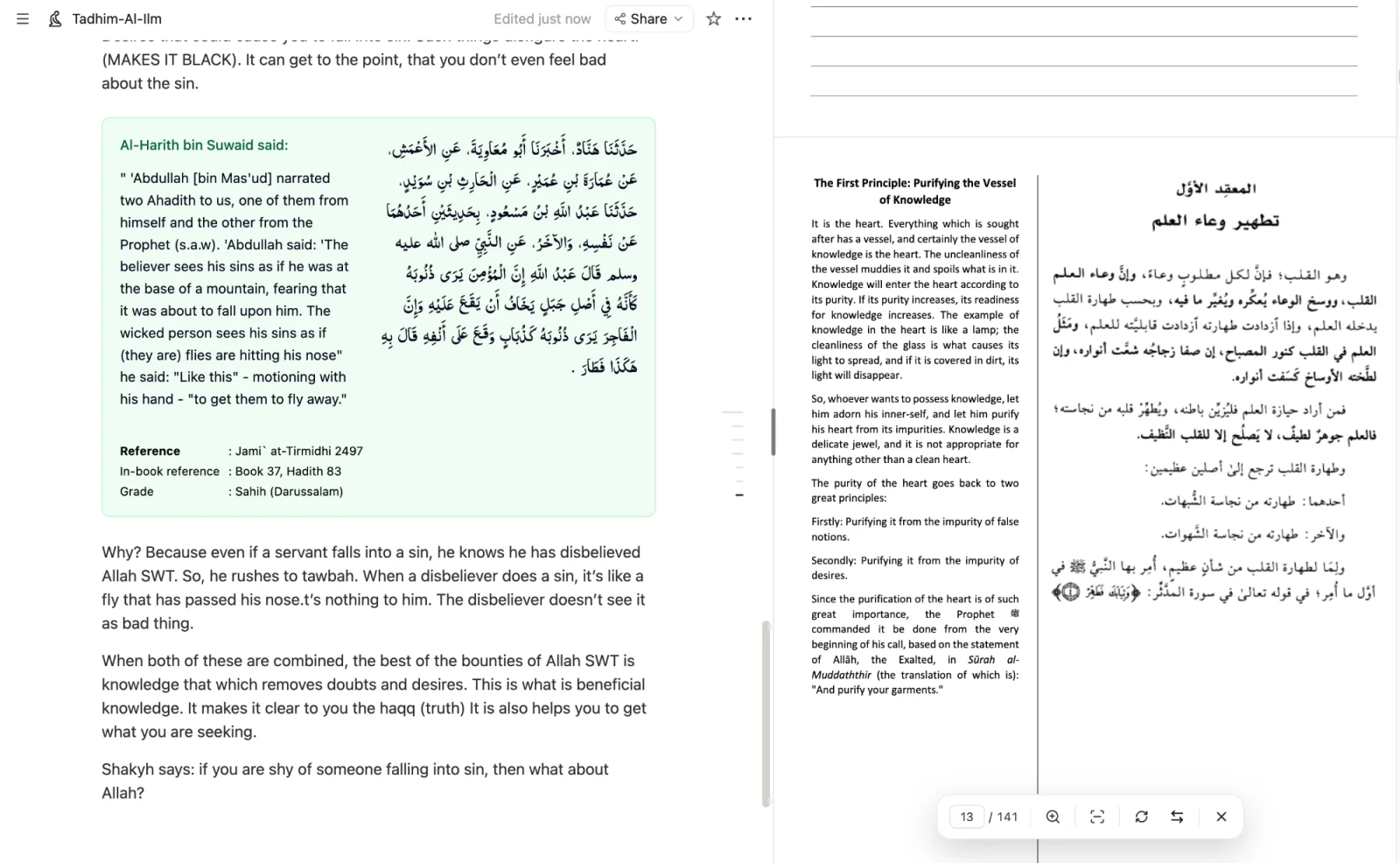
If you’re comparing options, see our guide to the best Islamic note-taking apps. For a step-by-step method, read how to take better Islamic study notes.
Begin this week
Three steps are enough to begin:
- Choose a subject. One, for now.
- Find a teacher. Use the checks above.
- Start studying. Attend the first lesson and write your first note.
May Allah سبحانه وتعالى grant us beneficial knowledge and the ability to act upon it. Ameen.